
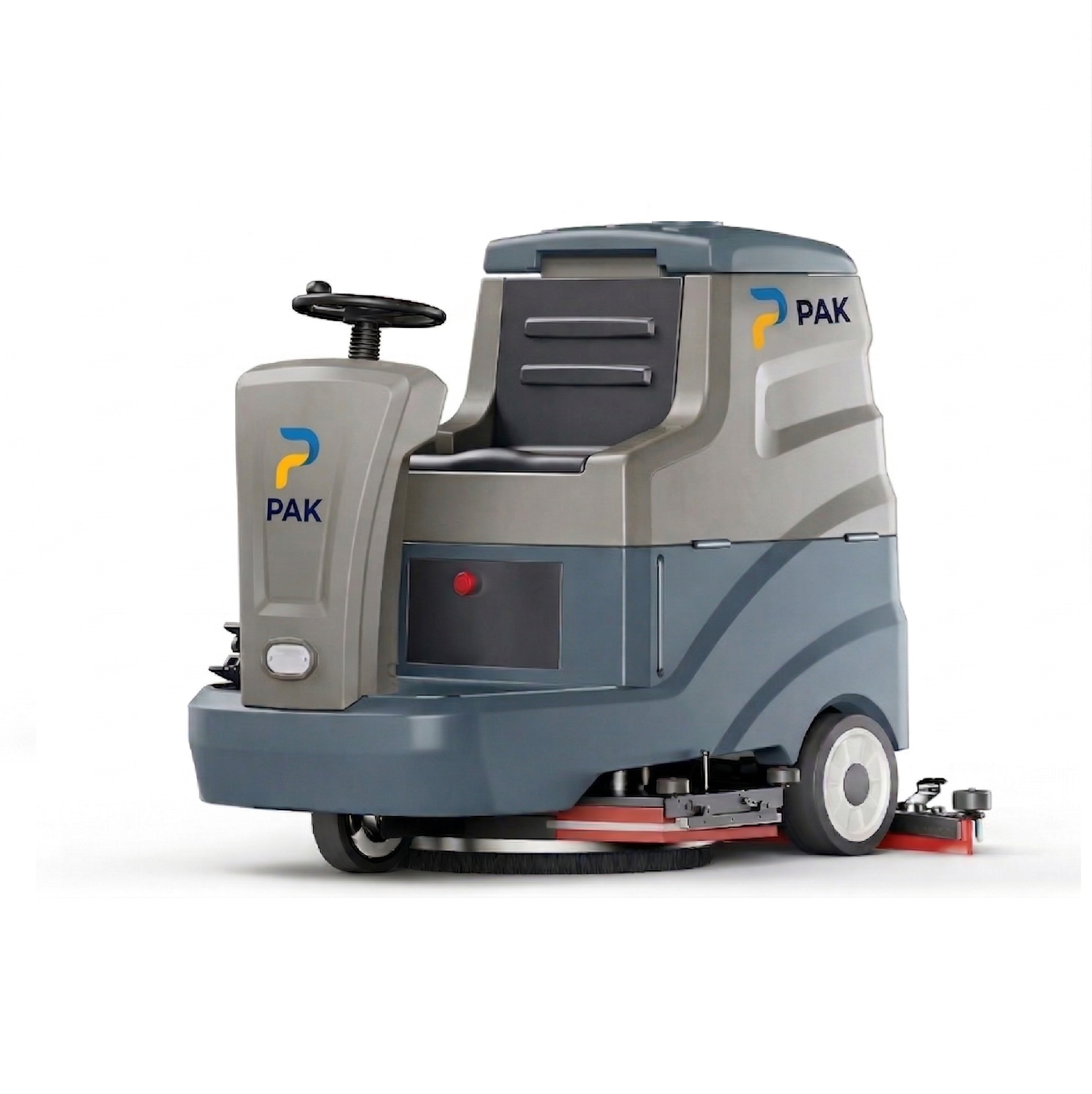
Cleaning an enclosed parking garage differs from ordinary indoor cleaning because of vehicle traffic, columns, ramps, tire marks, oil residue and sand carried in from outside. The right machine must suit the garage in maneuverability, water recovery and safe routing as well as working width.
Divide the garage into cleaning zones
Assess main driving lanes, parking bays, ramps, entrances and exits, elevator approaches and pedestrian crossings separately. When calculating net area, exclude spaces blocked by parked vehicles and areas around columns. The same machine may perform differently in wide lanes and narrow parking bays.
The right process for oil and tire marks
First collect sand, stones and loose waste. Use a chemical and contact time compatible with the floor coating in oily areas. Match pad or brush hardness to the surface for tire marks. An unsuitable chemical or excessive mechanical action can dull epoxy, making a small-area trial important.
When does a ride-on machine offer an advantage?
In garages with wide, open, long lanes on each floor, a ride-on floor cleaning machine can reduce the distance the operator walks. Compare PAK 500 S as a compact ride-on option with PAK 650 S for greater tank capacity and working width. Always measure the narrowest doorway, turns around columns and ramp transitions.
When should a battery walk-behind model be chosen?
For small floors, closely spaced columns, narrow bays or movement between floors by elevator, battery floor cleaning machines can be more agile. Some sites use a ride-on for main lanes and a compact battery machine for edges and tight areas.
Ramp and safety checks
Confirm the permitted gradient in the machine’s documentation. Avoid sudden turns on ramps, and separate wet working areas from vehicle traffic. Before each shift, inspect squeegee contact, lights and warning equipment, brakes and steering controls.
Measure actual capacity
Catalog capacity enables comparison on open, level areas. Turning around columns, cleaning bays, ramps, waiting for vehicles and handling water lengthen the actual time. Measure total time on a pilot route representative of one floor to determine the required number of machines or shifts more accurately.
Include ventilation and cleaning frequency in the plan
When choosing chemicals for an enclosed garage, consider ventilation and the safety data sheet. Do not mix chemicals arbitrarily; operators should use appropriate personal protective equipment. Busy entrances and exits need daily or more frequent checks, while lightly used floors can follow a different schedule.
A zone-based program matched to dirt load uses machine and operator time better than cleaning the entire garage in one session. Heavily soiled entrance ramps, payment areas and elevator approaches can form a separate route; long driving lanes can form the regular main route. Record each route’s start and finish times to reveal actual capacity.
Information to share before requesting a quotation
- Number of floors and net area per floor
- Narrowest passage and ramp details
- Floor coating
- Extent of oil and tire marks
- Hours with low vehicle traffic
- Water, drainage and charging points
Browse floor cleaning machines for all models and the buying guide for the complete selection method.
Frequently asked questions
Can a mains-powered machine be used in a parking garage?
Yes, where sockets and a safe cable route are available. However, vehicle traffic means cordless options simplify operations in many projects.
Can a ride-on machine operate on a ramp?
Only within the gradient and operating conditions permitted in that model’s technical documentation.
How should oily water be discharged?
Follow the facility’s wastewater procedure and local rules. Do not discharge oily waste directly into an unsuitable drain.
Continue reading
How to Choose a Floor Scrubber: Walk-Behind or Ride-On
Compare walk-behind and ride-on floor scrubbers by usable area, floor type, power supply, access width, tanks and real cleaning time.
Read article
Floor Scrubber Types: Corded, Battery and Ride-On
Compare mains-powered, battery-powered and ride-on floor scrubber dryers with floor scrubbing equipment. Review the model and tank details before purchase.
Read article
Choosing a Machine for Factory and Concrete Floor Cleaning
Match factory floor equipment to concrete or epoxy, dust and oil, production routes, shifts and measurable cleaning results.
Read article