
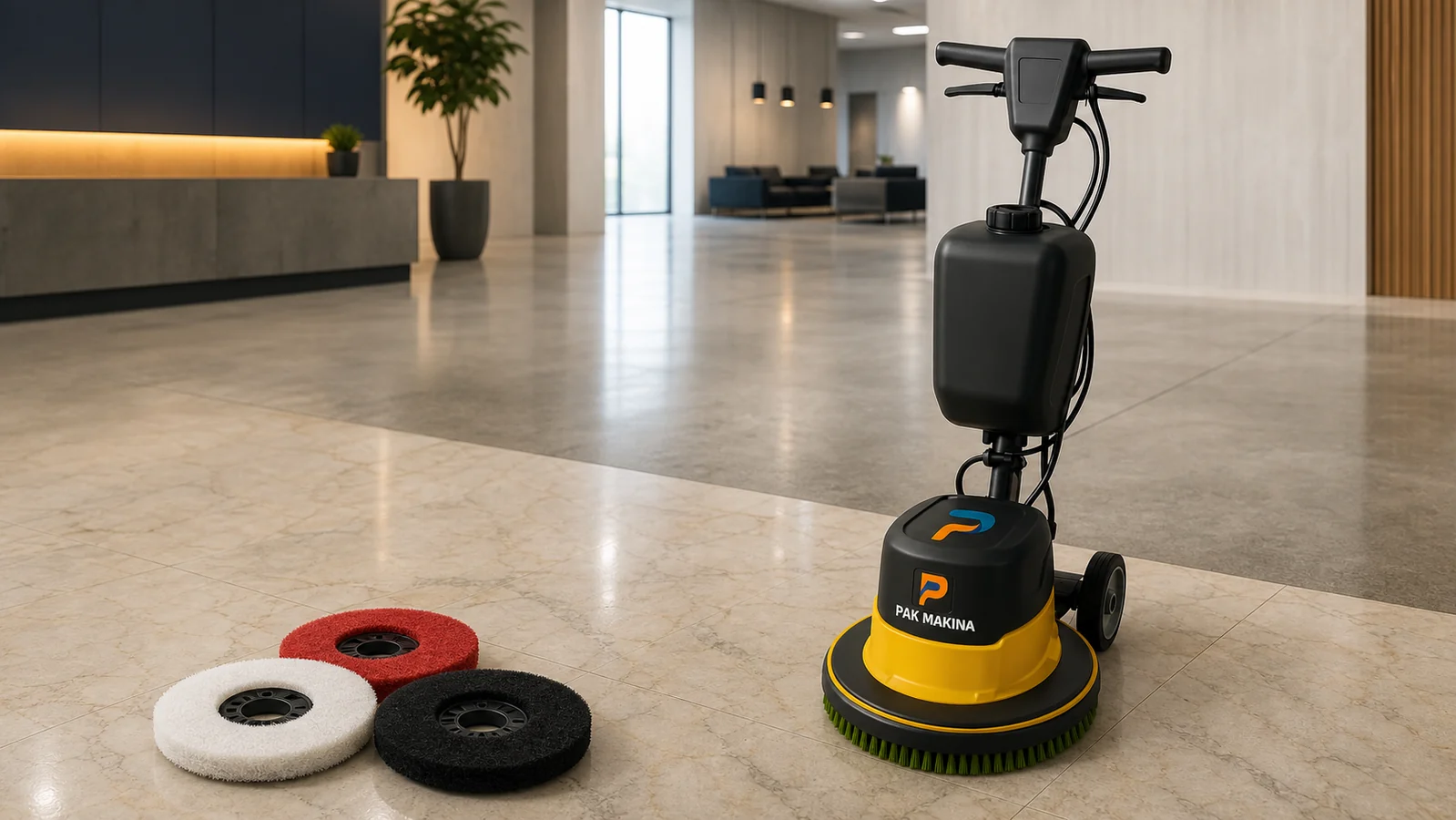
Choosing pads and brushes for a floor cleaning machine is as important as its power. An overly aggressive pad can damage polish or a surface coating; one that is too soft may fail to remove dirt and prolong the job. Choose consumables together with surface type, dirt level, chemicals and machine speed.
This guide offers a practical method for floor-care teams in hotels, stores, factories, warehouses, parking facilities and institutional buildings. First consult the floor cleaning machine selection guide to choose a machine class, and the floor cleaning machines category for products.
Identify the floor and its existing coating first
Two similar-looking floors may need different care. Natural stone, ceramic, epoxy, PVC, linoleum and power-troweled concrete do not have identical chemical or mechanical resistance. Where polish or a protective film is present, determine whether the goal is daily cleaning, buffing or stripping the old coating.
Test a small, inconspicuous area before starting. If you see pad marks, discoloration, dulling or surface fibers lifting, switch to a softer consumable and lower pressure.
What do pad colors generally mean?
Many products follow a pattern of increasing abrasiveness from light to dark colors, but color standards can differ between manufacturers. The table is general guidance; the selected pad’s technical data sheet always takes priority.
| General pad group | Common use | Main risk |
|---|---|---|
| White | Light buffing and delicate surface care | May be insufficient for heavy dirt |
| Red | Light daily cleaning and spray maintenance | May leave marks with unsuitable chemicals |
| Blue | Medium cleaning | May dull delicate finishes |
| Green | Stronger scrubbing and heavy dirt | May abrade a protective coating |
| Black | Heavy work such as stripping coatings or polish | Permanent scratches and dulling on an unsuitable surface |
Diamond pads and specialist surface pads may fall outside this color scheme. For marble polishing, concrete polishing or specialist coating maintenance, plan every stage according to the same manufacturer’s procedure.
When is a brush more suitable than a pad?
Bristles can reach joints and textures a pad cannot fully contact. A brush may give more even results on non-slip ceramic, textured concrete, rough epoxy or deeply jointed areas. Select bristle material and stiffness for the surface.
- Soft nylon brush: controlled daily maintenance of delicate or lightly soiled surfaces.
- Medium brush: ceramic, epoxy and general facility cleaning, after a surface trial.
- Stiff brush: heavy dirt on robust, textured surfaces; take care with delicate coatings.
- Abrasive/grit brush: only on suitable hard surfaces under controlled conditions.
Compare single-disc systems on the floor scrubbing and polishing machines page.
Matching pads and brushes to the surface
| Surface | Starting approach | Checks |
|---|---|---|
| Polished marble or natural stone | Soft pad and a suitable neutral cleaner | Test for gloss loss and staining |
| Ceramic and jointed areas | Medium/soft brush or a suitable pad | Joint erosion and splashing |
| Epoxy coating | Soft-to-medium consumable recommended by the coating manufacturer | Dulling, scratching and chemical compatibility |
| PVC or linoleum | Soft pad and low-risk chemical | Heat, color transfer and coating condition |
| Power-troweled concrete | Pad or brush matched to dirt level | Surface hardener and target gloss |
| Textured non-slip floor | A brush of suitable stiffness that reaches the surface | Bristle marks, joints and coating resistance |
How do machine pressure, speed and chemicals affect the result?
The same pad can behave differently on different machines. Machine weight, pad pressure, rotational speed and travel speed alter abrasion. Staying in one place too long can heat the surface or leave marks.
Using more chemical does not ensure better cleaning. It can leave residue, clog the pad with dirt more quickly and make the floor slippery. Use the recommended dilution, recover dirty solution before it dries and make a rinsing pass where needed.
The correct working sequence
- Sweep away sand, metal swarf and loose dirt.
- Identify the floor and existing coating.
- Test a small area with the softest reasonably suitable pad or brush.
- Prepare the chemical at the label’s dilution.
- Move the machine in regular, overlapping passes.
- Collect dirty water promptly and check the squeegee blades.
- After drying, inspect the surface from different angles.
Maintenance that extends pad and brush life
If both sides are suitable for use, regularly turning a pad can balance wear. Remove the pad or brush after work, clean it appropriately and dry it with air circulation. A wet pad left under the machine can develop odors, lose its shape and run unevenly.
Check that the center hole and pad driver are seated correctly. An unbalanced or torn pad can cause vibration. Replace brushes when bristles remain bent in one direction or become too short to reach and clean the surface properly.
Common selection and operating mistakes
A common mistake is assuming a harder pad always speeds up the job. Greater hardness increases the risk of surface damage. Continuing to use a dirty pad can drag sand and metal particles across the floor and scratch it. Using the same pad with different chemicals without thorough cleaning can also cause unwanted reactions and residue.
Keep the power cable out of the pad’s path while the machine runs. Do not force the machine around turns; confirm the pad driver is fully locked and the operator wears slip-resistant footwear. Do not apply fresh polish or protection to a stripped area until it has been thoroughly rinsed and neutralized.
Frequently asked questions
Do pad colors mean the same thing for every brand?
No. Increasing hardness from white to black is a common market convention, but products vary by brand. Use the pad data sheet and a small-area trial as the basis.
Does a brush or a pad clean better?
A pad may suit flat, coated surfaces better; a brush may suit joints and textured surfaces. The right choice depends on the surface, dirt and intended treatment.
Can a black pad be used on marble?
Black pads are generally intended for aggressive stripping and can dull polished marble. Do not use one without the surface manufacturer’s approval and a small-area test.
When should a pad be replaced?
Replace it when it becomes thin, its fibers are loaded with dirt, wear becomes uneven, or performance remains poor after cleaning.
Continue reading
How to Choose a Floor Scrubber: Walk-Behind or Ride-On
Compare walk-behind and ride-on floor scrubbers by usable area, floor type, power supply, access width, tanks and real cleaning time.
Read article
Floor Scrubber Types: Corded, Battery and Ride-On
Compare mains-powered, battery-powered and ride-on floor scrubber dryers with floor scrubbing equipment. Review the model and tank details before purchase.
Read article
Choosing a Machine for Factory and Concrete Floor Cleaning
Match factory floor equipment to concrete or epoxy, dust and oil, production routes, shifts and measurable cleaning results.
Read article